When the weather outside turns frightful, ham radio operators usually pack up their gear, head out into the cold, and set up field stations. That was the plan for our local amateur radio club during the weekend of January 23–26.
Then North and Central Texas got a reality check.
A powerful winter storm swept across much of the eastern CONUS, dropping a heavy cocktail of freezing rain, sleet, and snow across Texas. Down here, municipal fleets don’t have arrays of sand trucks or de-icing equipment standing by. Within hours, roads turned into sheets of solid ice, thousands of flights were canceled, schools closed, and travel became hazardous. Even after the frozen precipitation stopped, frigid temperatures locked everything in place for days.
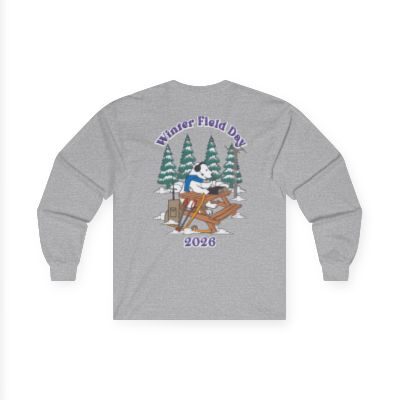
Safety comes first in amateur radio. Our club made the smart call to cancel our scheduled group Winter Field Day (WFD) site deployment. But I wasn’t about to let Winter Field Day go to waste (besides I already bought the shirt).
Instead, I pivoted: I ran my own Home-Shack Winter Field Day, operating entirely on battery power, testing an HOA stealth antenna, and making my very first contacts on JS8Call and RTTY.
Simulating Emergency Power in the Home Shack
Fortunately, our power grid held up at my house during the storm, so we kept our lights and heat on. However, to stay true to the spirit of Field Day, I disconnected my HF transceiver from the wall power supply and plugged directly into my emergency battery setup.
Running off a deep-cycle battery setup proved two things:
- Efficiency Matters: Modern HF rigs consume very little current on receive, making long-period battery operations completely viable.
- Confidence in Power Loss: Knowing that I can sustain HF operations during an actual power outage gives me peace of mind for real-world emergency communications (EmComm).
HOA Constraints: The Rain Gutter “HOA Buster” Antenna
Like many hams in suburban Texas, I operate under strict Homeowners Association (HOA) covenants—meaning no giant towers or full-size directional Yagis in the yard.
For this operating session, I relied on my Alpha Antenna’s HOA Buster Rain Gutter Antenna setup. This right now is my standard home shack antenna, I do plan to add an End Fed Random Wire “Fence Tenna” as well at some point but truthfully I’ve been very happy with the performance of the gutter antenna.
While a rain gutter isn’t a resonant dipole up 50 feet in the air, pairing it with an internal antenna tuner allowed me to match on multiple bands. Signals made it out clearly, proving that you don’t need an elaborate antenna farm to make contacts during contest and field day operations.
Trying Out New Modes: JS8Call & RTTY
One of my favorite aspects of amateur radio is that there is always something new to learn. Having spent most of my digital time on FT8, I decided Winter Field Day was the perfect opportunity to dive into two modes I had never logged before: JS8Call and RTTY (helps of course that FT8/4 are not allowed in Winter Field Day comms, see my last post for an explanation).
JS8Call
JS8Call takes the weak-signal robustness of FT8 and pairs it with real-time keyboard-to-keyboard messaging and store-and-forward relay capabilities.
- The Experience: It was fascinating watching messages hop across nodes during a regional weather emergency. It’s an incredibly valuable tool for low-power (QRP) or compromise-antenna stations. I was even able to get my neighbor in a JS8Call QSO in my log book.
RTTY (Radioteletype)
RTTY is one of the oldest digital modes in amateur radio, using frequency-shift keying (FSK/AFSK) to transmit text.
- The Experience: Hearing the rhythmic “diddle-diddle” of RTTY across the HF bands during a contest is classic ham radio. Tuning in signals and managing the bandwidth required a bit of a learning curve compared to modern software interfaces, but making those first few contacts on a classic mode was genuinely satisfying.
Key Takeaways for New & Prospective Hams
If you’re studying for your license or recently got on the air, here are a few key lessons from my winter experience:
- Flexibility is Key: Emergency communications is all about adaptability. If Plan A (club field setup) gets rained or iced out, pivot to Plan B (home shack, mobile, or backyard QRP).
- Don’t Let HOA Restrictions Stop You: Between rain gutters, magnetic loops, end-fed random wires, and indoor dipoles, there is almost always a way to get on HF.
- Try One New Thing Every Event: Whether it’s operating on battery power, building a wire antenna, or trying a digital mode like JS8Call, use field days as a playground to expand your skills.
Looking Ahead to June
While Texas winter storms can freeze the roads and shut down field plans in January, I have a strong feeling our club’s ARRL Field Day in June won’t be canceled on account of ice! We’ll likely be fighting 95°F heat and humidity instead—but that’s half the fun of ham radio.
Did you participate in Winter Field Day this year? What modes or power setups did you test? Drop a comment below or catch me on the bands!
73,
Chris - K5CTW
The Ham Radio Lab