Is APRS Still Relevant? The Past, Present, and Smartphone Future of Packet Radio
First I’m Back!!!! Sorry I was gone for a while and frankly posts between now and the new year are going to be spotty at best with the work and hte holidays. But never fear my readers today I am going to touch on a polarizing subject with some folks the Automated Packet Reporting system or APRS
If you spent any time listening to local VHF radio traffic, you’ve likely heard it: that unmistakable, high-pitched 1200-baud chirp cutting through 144.390 MHz. That sound is an AX.25 packet carrying data across the Automatic Packet Reporting System (APRS) network.
As a ham operator, I find APRS to be one of the most intriguing crossover points between legacy RF engineering and modern digital networking. Yet, a common debate persists in clubhouses and online forums: Is APRS a relic of the 1990s, or is it an essential tool for modern amateur radio?
APRS is not only still relevant, but it is also primed for a massive renaissance—provided the ham radio industry embraces modern, open smartphone integration over locked-down radio interfaces.
What is APRS, and How Did It Start?
APRS was created in the late 1980s and early 1990s by Bob Bruninga (WB4APR) (SK). Initially named the Automatic Position Reporting System, Bob later re-titled it the Automatic Packet Reporting System to emphasize that position tracking was merely one feature of a much broader real-time tactical communications system.
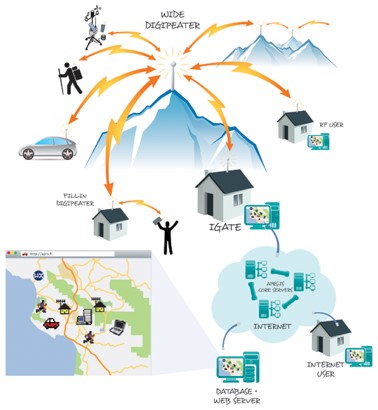

APRS Network: From local RF digipeating to global internet gateways (IGates).. Source: School Amateur Radio Club Network
The Core Concept: Local Tactical Awareness
Unlike traditional packet radio, which focused on point-to-point connected sessions (similar to terminal telephone calls), APRS operates on a one-to-many broadcast model:
- Connectionless Packets: Every station transmits unnumbered UI (Unconnected Information) frames. Anyone listening on the frequency receives the data instantly.
- Smart Digipeating: Local repeater nodes (Digipeaters) relay packets using standardized path routing (e.g., WIDE1-1, WIDE2-1) so signals travel across geographic regions without flooding the channel.
- Information Beyond GPS: From its inception on 144.390 MHz (in North America), APRS was built to transmit:
- Positions & Beacons: GPS coordinates, altitude, course, and speed.
- Short Messages: Two-way person-to-person tactical text messaging.
- Weather Data: Local weather station telemetry (wind speed, temperature, pressure).
- Objects & Items: Map markers dropped by operators to pinpoint hazards, checkpoints, search-and-rescue teams, or temporary repeaters.
According to official reference archives at aprs.org, Bob Bruninga designed APRS primarily for immediate, local situational awareness on a shared display—a digital map showing where everyone and everything was during a public service event or emergency.
Is APRS Relevant Today?
Critics sometimes claim APRS is obsolete because cellular networks, satellite messengers (like Garmin inReach), and smartphone messaging apps exist. As discussed in community resources like k8mrdiswrong.com, viewing APRS strictly as a consumer GPS tracker misses its core engineering purpose.
APRS shines precisely where commercial infrastructure fails: decentralized, off-grid tactical communication.
                                  ┌──────────────────────────┐
                                  │   APRS RF Network        │
                                  │   (144.390 MHz VHF)      │
                                  └────────────┬─────────────┘
                                               │
                   ┌───────────────────────────┼──────────────────────────┐
                   ▼                           ▼                          ▼
        ┌───────────────────────┐     ┌────────────────────┐     ┌────────────────────┐
        │ Off-Grid Tracking     │     │ Tactical Messaging │     │  SMS Gateway       │
        │ Vehicle/Hiker location│     │ Direct radio-to-   │     │ Text cell phones   │
        │ without cell service  │     │ radio text packets │     │ via SMSGATE bridge │
        └───────────────────────┘     └────────────────────┘     └────────────────────┘
Key Modern Use Cases
- Emergency Communications (EmComm): During floods, wildfires, or grid outages, APRS operates completely independent of commercial internet or cellular towers. Incident command can drop object markers for water distribution points, hazards, or mobile medical units directly onto local operator screens over RF.
- SMSGATE & Satellite Interoperability: Through APRS gateways like SMSGATE, a ham deep in the backcountry without cell coverage can send a direct text message to a family member’s standard mobile phone over VHF radio.
- Overlanding and Remote Tracking: When traveling through remote corridors, beaconing APRS lets local IGates pick up your position and relay it to family members at home without requiring expensive satellite subscriptions.
- Telemetry and Weather Monitoring: Remote mountain weather stations regularly report atmospheric data directly into the APRS mesh, giving local operators hyper-local ground truth during severe weather events.
The Hardware Bottleneck: Proprietary Locked UIs vs. Modern Bluetooth TNCs
If APRS is so capable, why isn’t every ham using it daily? The primary barrier to entry has historically been the radio manufacturers.
For years, the “Big Three” radio manufacturers integrated APRS by embedding a Terminal Node Controller (TNC) inside high-end handhelds or mobile rigs, but locked the data inside a tiny, low-resolution radio screen. Entering an APRS text message on a 1990s-style numeric keypad or tiny dot-matrix display is frustrating, to say the least.
TRADITIONAL APRS SETUP: [Radio with Internal TNC] ───► [Tiny Dot-Matrix Display / Numeric Keypad] * Difficult to type messages * Low-resolution monochrome maps (or no maps at all) * Closed, proprietary interface
MODERN OPEN SETUP: [HT with Bluetooth TNC] ──(Bluetooth LE)──► [Smartphone / Tablet App] * Full touch-screen keyboard * Rich offline vector maps (APRSdroid / APRS.fi app) * Open software updates & continuous improvements
The TNC Configuration Headache
Operators looking for better mapping software traditionally turned to external TNC interfaces:
- Audio Interfaces (Digirig, Soundmodem): Require custom audio cables, soundcard level calibration, VOX adjustment, and complex baud rate configurations.
- External Bluetooth TNCs (MobiLinkd TNC3/TNC4): A major step forward, but still require buying a separate battery-powered dongle, maintaining extra cables, and troubleshooting pairing quirks across devices.
The Game-Changer: Built-in Bluetooth TNCs in Modern Radios
The most exciting development in recent years comes from newer radios entering the market—such as the Kenwood TH-D75 and the cheaper BTech UV-Pro and similar dual-band handhelds and mobile units.
These radios include a native, built-in Bluetooth TNC directly out of the box.
Instead of forcing you to navigate APRS on a tiny radio screen or wrestle with audio cables, the radio acts purely as the RF modem. You pair the radio to your iOS or Android device via Bluetooth, open an app like APRSdroid or the APRS.fi iOS app, and immediately enjoy:
- High-resolution, full-color maps with offline caching for backcountry use.
- Full QWERTY keyboard typing for instant messaging.
- Smooth touch controls for panning around local objects and stations.
- Zero cable clutter and no external battery dongles to charge.
This open approach decouples the RF layer (handled by the radio) from the User Interface layer (handled by smart devices), making APRS as intuitive as standard phone messaging.
Web Gateways: How the Public Views APRS Data
Another major strength of APRS is its bridge between analog RF and the digital web via IGates (Internet Gateways). An IGate is simply a dual-homed APRS station listening on 144.390 MHz that receives packets over the air and forwards them to the APRS-IS (Internet Service) backbone.
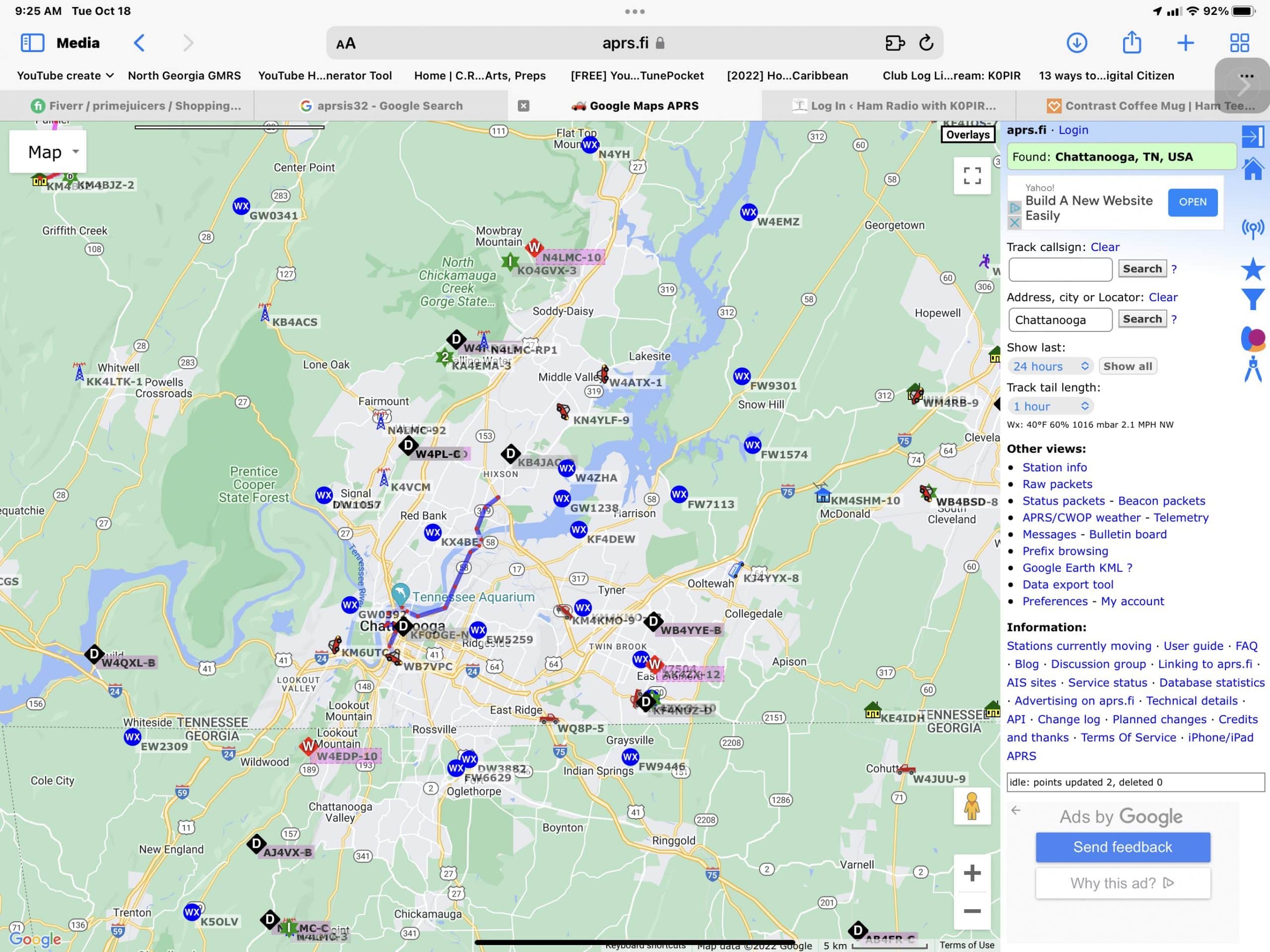

aprs.fi: A public web dashboard displaying real-time APRS packet data sent over RF.. Source: Ham Radio with K0PIR
Because of this bridge, non-licensed family members, emergency managers, and ground crews can monitor APRS activity in real time using public third-party web applications:
- aprs.fi: The premier web-based tracking platform. Enter any callsign or SSID (e.g., K5CTW-9) to view real-time location tracks, speed graphs, telemetry histories, and weather station outputs.
- aprs.direct: A clean, modern mapping alternative providing live visualization of packets, digipeater hop paths, and station statistics.
These web tools mean you don’t need a radio in hand to stay informed. A family member at home can watch an overlander’s track progress safely across an off-grid pass in real time.
Conclusion: The Path Forward for APRS
APRS is far from dead. It remains one of the most flexible, resilient, and useful protocols ever created for amateur radio. Whether used for tactical messaging during an off-grid event, tracking high-altitude balloons, or coordinating emergency communications during a hurricane, Bob Bruninga’s creation delivers unmatched utility.
However, for APRS to reach its full potential with the next generation of operators, major radio manufacturers must step up.
Walling off APRS inside proprietary radio menus with tiny screens is a bottleneck. The future of APRS lies in open, Bluetooth-enabled or wireless enabled TNC integration’s that lets operators leverage the hardware they carry every day, their smartphones and tablets.
Radios like the BTech UV-Pro, Kenwood TH-D75 have proven that low setup complexity and open app integration get hams on the air faster. Here’s hoping the rest of the industry follows suit.
Let me know your thoughts in the comments below.
73,
Chris - K5CTW
The Ham Radio Lab